


Description
This page deals with the identification of Ptolemy's catalog entries according to the authors of most editions presented on the catalog page, and related issues.
Identifications
The raw cross-references from various editions of the catalog and collected on the catalog page in their respective cross_*.dat files have been converted here to modern designations (Bayer, Flamsteed, HR, HD, HIP, SAO) in corresponding ident_*.dat files, in a manner consistent with the designations collected in the file star_ids.dat (described in this ReadMe file) represented on the reference maps.
Features of the identification files
More precisely, I have ensured that there is a well-defined relation (in the mathematical sense) between catalog stars and reference stars. If a catalog star, say for example Ptolemy's 315 Peg 1 has been assigned specific HR, HD, HIP, and SAO numbers (in this case HR 15, HD 358, HIP 677, SAO 73765), then there is a corresponding entry in the reference stars set with this exact combination of HR, HD, HIP, SAO numbers. Indeed there is one under the key value 358 (which happens to be the HD number but that is of no significance).
This constraint also applies when a reference star has more than one component. For instance, the reference star with key 213306, δ Cep, has two components, the first one identified as HR 8571, HD 213306, HIP 110991, SAO 34508, and the second one as HD 213307, HIP 110988, SAO 34506. The corresponding Ptolemy star 87 Cep~2 has been assigned these two combinations of numbers as well so that it corresponds exactly to the reference star keyed 213306.
Ideally, the relation would be one-to-many, and its inverse would be a (partial) function from the set of the reference stars to the set of catalog stars. A "one-to-many" case is Ptolemy's star 88 Boo 1, which maps to the reference stars keyed 124674 and 124675, κ1 Boo and κ2 Boo.
Duplicate catalog entries create "many-to-one" situations. For instance, Ptolemy's stars 670 Aqr 42 and 1011 PsA 1 both correspond to the reference star keyed 216956 (Fomalhaut). More complex situations are imaginable: we could have catalog star A corresponding to to reference stars X and Y, and catalog star B to reference stars Y and Z. This would be forbidden: duplicate catalog entries should correspond to the exact same reference star(s) (A and B both corresponding to X and Z would be acceptable).
The important point is that there be a well-defined relation from the set of catalog stars as identified in one of the ident_*.dat files to the set of reference stars. Apart from duplicate catalog entries, the relation should be one-to-many and its inverse a (partial) function.
I have enforced these constraints for all the non-telescopic catalogs, the ones before Flamsteed, and for Flamsteed's catalog as well. This makes it possible to programmatically establish unambiguous cross-references between these catalogs such as the ones shown in the files pto*_oo.dat or pto*_o.dat described below and similar ones on the other catalogs' pages (the o suffixes correspond to the suffixes of the ident_*.dat files used to establish the mapping). For instance, Ptolemy's 87 Cep~2 is shown to match Ulugh Beg's 87 Cep~2, Tycho Brahe's Cep 6, and Flamsteed's Cep 27, at least according to particular identifications files.
The situation is a little more complicated for telescopic catalogs (Lacaille, Piazzi, …) which have "higher resolution" than the non-telescopic ones and include stars that are not part of the reference star set. This is discussed elsewhere. The correspondence between reference catalogs (Bright Stars, Henry Draper, Hipparcos and SAO) implied by the grouping of HR, HD, HIP, SAO numbers in reference star entries is itself a delicate problem that is discussed on the Reference Star Set page.
Identifications files
The files ident_*.dat listed below summarize the star identifications according to various editors of the catalog and the ones that I have retained for the maps and other considerations. The file format is described in the ReadMe file and they are subject to automatic validation with the Anafile package.
| File name | Description |
|---|---|
| ReadMe | File descriptions |
| ident_t.dat | Identifications according to Toomer |
| ident_p.dat | Identifications according to Peters & Knobel |
| ident_b.dat | Identifications according to Baily |
| ident_m.dat | Identifications according to Manitius |
| ident_z.dat | Identifications according to Flamsteed |
| ident_j.dat | Identifications according to John Pratt |
| ident_a.dat | Identifications according to VizieR J/A+A/544/A31 |
| ident_f.dat | Identifications according to Flamsteed's catalog |
| ident_o.dat | Identifications retained for the maps etc. |
| notes_id.dat | Explanation of some identification choices in ident_o.dat |
The file ident_o.dat collects the identifications that I feel more comfortable with, and should by no means be considered authoritative. I have followed one author or another in most cases, leaving stars unidentified in the most perplexing cases. The file notes_id.dat comments on some of my choices.
Building the identification files from the cross-references given in various editions of the catalog presents its own challenges. The main one is to correctly interpret Bayer letters, which have shifted over time due to the contributions of several authors. Most notably, Baily and Flamsteed use the original lettering of Bayer in Argo Navis, Centaurus, Lupus, Ara, and Corona Australis, while Toomer, Peters, and Manitius use a "post-Lacaille" lettering. Flamsteed also uses some of the letter assignments that he introduced in his own catalog.
It can also be unclear which component(s) of a multiple star is referred to by a Bayer letter. For instance, π UMa in Flamsteed's version of the catalog is interpreted as π1 UMa and π2 UMa (in accordance with Flamsteed's assignments in his own catalog). In Toomer's version, ν Lyr is interpreted as ν2 Lyr only. The identification files flag the latter situation by an asterisk between the Bayer letter and index.
Cross-references also involve Flamsteed numbers, HR numbers, or designations from less common catalogs such as Hevelius, Lacaille, Piazzi, Groombridge, Heis. These present few challenges in general, since the positions they provide have close matches in modern catalogs. A few cases remain where I couldn't figure out which catalog was referred to or where I don't have access to the catalog at the moment (Ambronn is one).
Cross-references
The files below cross-reference Ptolemy's catalog with a few later ones (Ulugh Beg, Tycho Brahe, Flamsteed) and with the reference star set, according to the identifications in ident_o.dat and similar identification files for the other catalogs (and found on their respective pages). They are described in ReadMe.
| File name | Explanation |
|---|---|
| ptobeg_oo.dat | Cross-references to Ulugh Beg's catalog |
| ptotyc_oo.dat | Cross-references to Tycho Brahe's catalog |
| ptoflm_o.dat | Cross-references to Flamsteed's catalog |
| ptoref_o.dat | Cross-references to the reference star set |
The left columns list the Ptolemy catalog designations in their natural order and the right columns the other catalog's designations. A special character between the two qualifies the relationship:
| = | the entries have the same identification |
| > | the catalog entry includes the other catalog's entry |
| < | the catalog entry is included in the other catalog's entry |
| ~ | the entries have at least one component in common but otherwise differ |
| x | the catalog entry is identified but has no match in the other catalog |
| * | the catalog entry is unidentified |
This list shows all possible relationships but I have made sure that the identifications are chosen so that the case ~ never happens: it would mean for example that the first catalog entry is identified as components X and Y and the second catalog entry as components Y and Z. It is hard to imagine how that could be justified.
The situation < does not happen either for Ptolemy's catalog, which means that it is "more granular" (at least not less granular) than the others. The > situation does occur with respect to Flamsteed's catalog and the reference star set: for instance, Ptolemy's 45 Dra 2 comprises Flamsteed's 24 Dra and 25 Dra.
Accuracy of the catalog
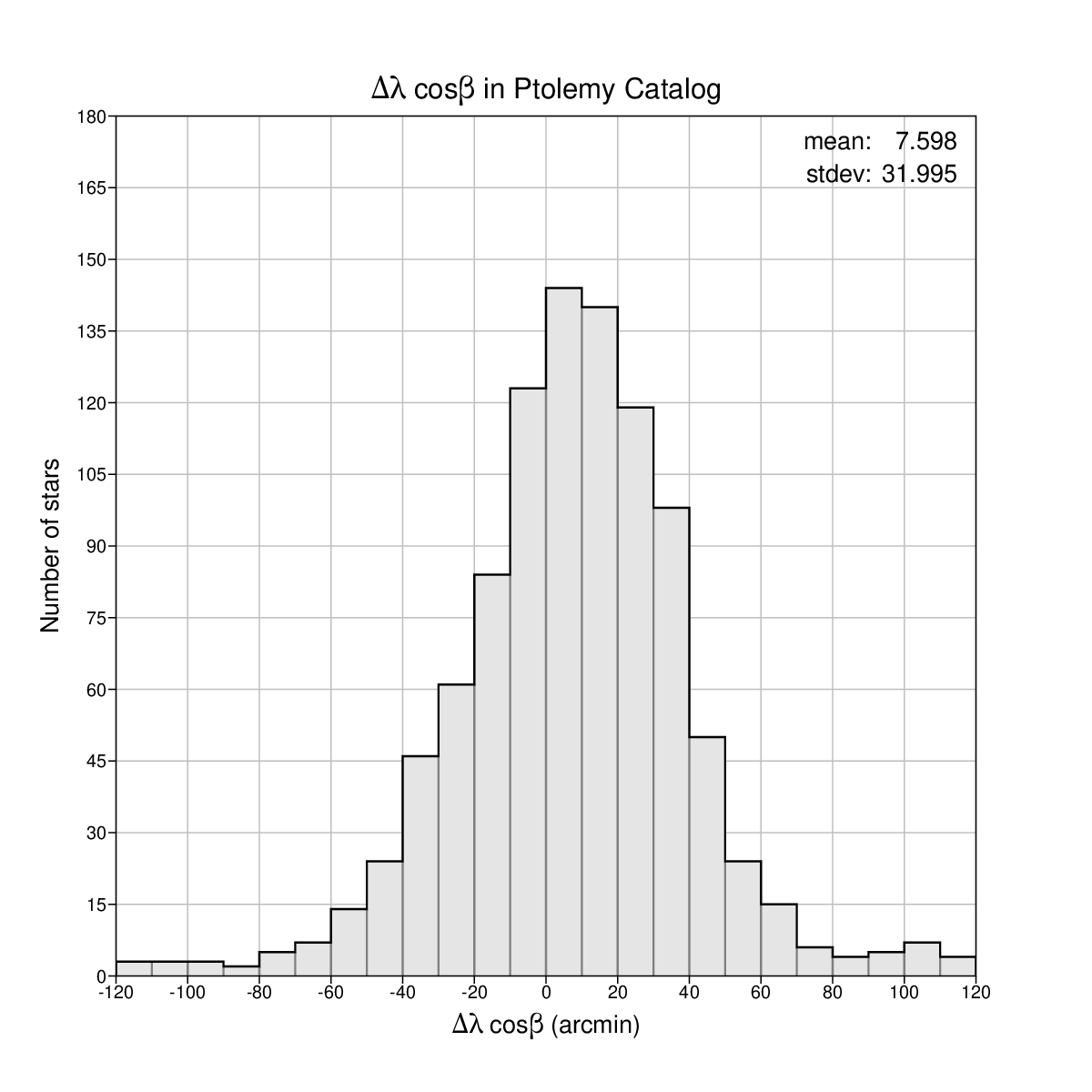
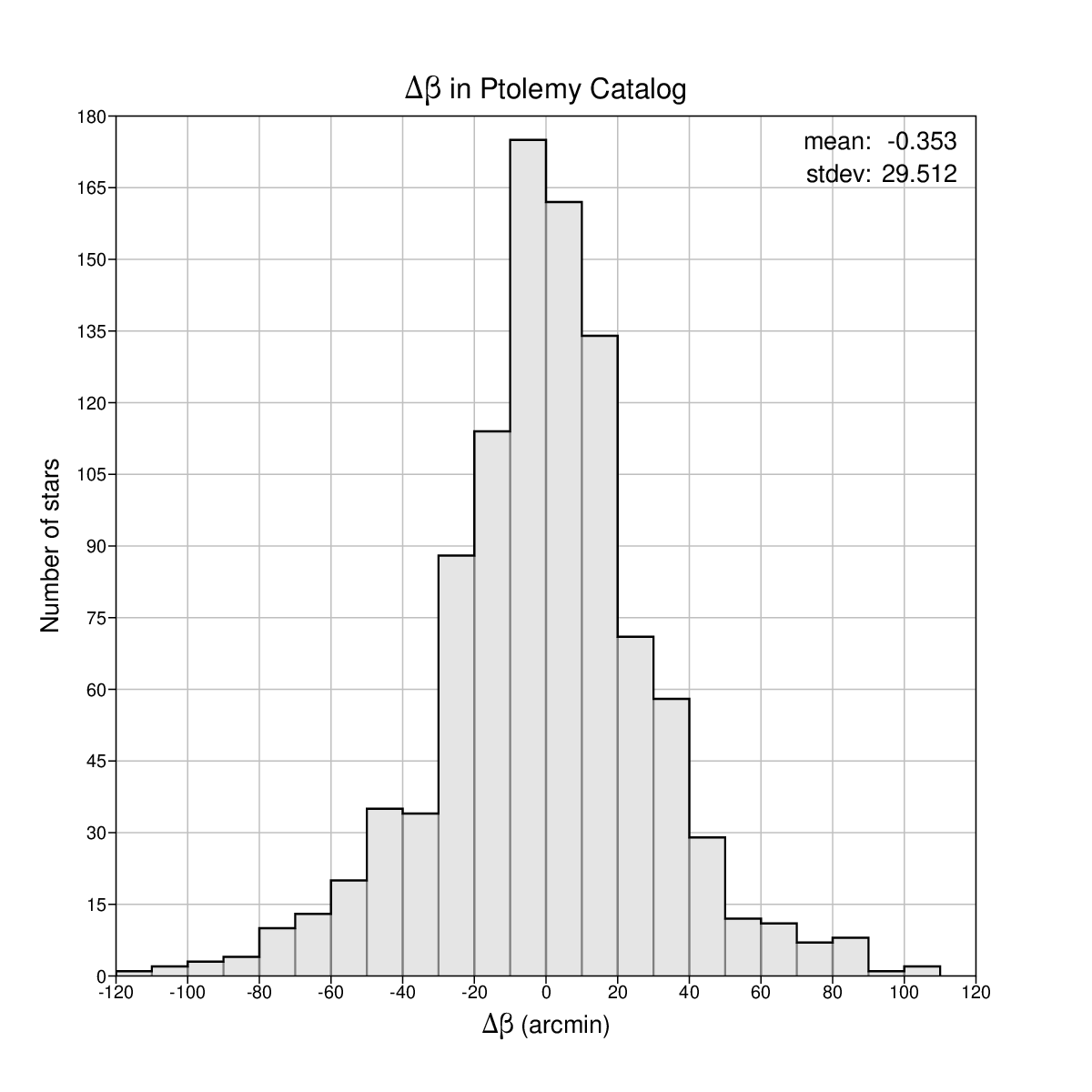
The file dists_to.dat, also described in ReadMe gives the differences between Ptolemy's positions (according to Toomer's version) and modern positions of the corresponding stars (according to ident_o.dat) from the Hipparcos or the SAO catalog, adjusted to Hipparchus's epoch and Ptolemy's equinox.
| File name | Explanation |
|---|---|
| dists_to.dat | Differences between Ptolemy's positions and modern ones |
The file gives differences in ecliptic longitude (multiplied by the cosine of the latitude for normalization), differences in ecliptic latitude, and great circle distances, all in arcminutes. The corresponding histograms below give an idea of the overall accuracy of the catalog (data outside the range of the x axis has been discarded).
| Longitude | Latitude | Distance |
|---|---|---|
 |
 |
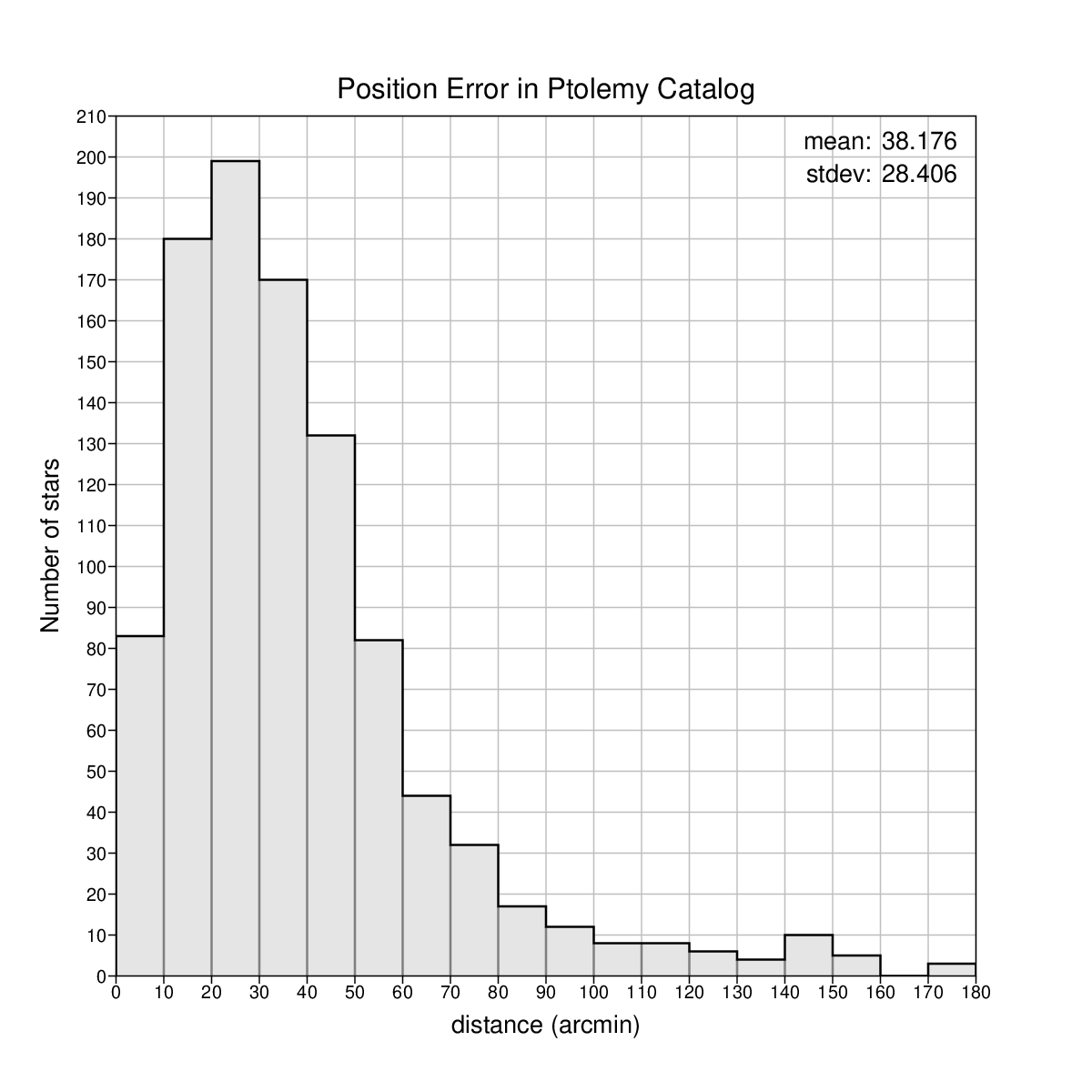 |
The article by R. Verbunt & R. H. van Gent [1] includes similar diagrams and a detailed statistical discussion. I just want to note the position of the peak of the distance histogram, at about 30 arcminutes, and use it as a rough but objective measure of the catalog's general accuracy.
If two independent variables X (the normalized difference in longitude) and Y (the difference in latitude) have normal distributions with mean 0 and the same standard deviation σ, then the distribution of the variable Z = √X2+Y2 (the distance, approximately) is the Rayleigh distribution, with probability density g(x) = x / σ2 . exp(-x2/(2σ2)) for x ≥ 0. This function has a maximum at x = σ.
The assumptions about X and Y seem to hold fairly well in this case, so that σ is also the approximate position of the peak.
References
[1] F. Verbunt and R. H. van Gent, The star catalogues of Ptolemaios and Ulugh Beg, Astronomy & Astrophysics, 455, A31 (2012).